Legal Proceedings to Bring Leon Home
Last updated September 29, 2026 (corrected Constitutional Court and cassation status; Moscow City Court appeal hearing of 8 September 2026)
Table of Contents
- Background
- Hague Convention Case
- Paternity and Custody Lawsuit
- Visitation Lawsuit and Complaints
- Criminal Complaint Against Guardianship Officials
- Documentation of Anna Lyudniovskova’s Arrest in Finland
- Strategic Communication and Political Support
- Constitutional Court Challenge
- Legal Opinion on Guardianship Violations (2025)
- Court Decision Denying Visitation (12 December 2025)
- Counsel Memorandum (December 2025)
- December 2025 Lawyer’s Note – Strategy & “Dolina Case” (External Update)
- AI Analysis: Judicial Bias in the Levenstein Case (External Update)
- Nicholas’ Reply to the Lawyers’ Memorandum (December 2025)
- Counsel Memorandum Update (February 2026)
Background
After the passing of Leon’s mother in December 2023, guardianship over Leon was given to his maternal uncle, Andrei Malevanny, without informing the child’s father, Nicholas Levenstein. Despite holding full parental rights, Nicholas has been denied custody and even visitation. Below are the key early events:
- Dec 5, 2023 – Death of Anna Lyudinovskova (Leon’s mother).
- Dec 6, 2023 – Preliminary guardianship granted to Andrei Malevanny (Appendix No. 11).
- Dec 21, 2023 – Nicholas learns of mother’s death through acquaintances.
Hague Convention Case
This case, filed in April 2024, sought Leon’s return to Malta under the Hague Convention on International Child Abduction. Courts repeatedly rejected Nicholas’s petitions.
- Apr 2024 – Hague petition filed in Tverskoy District Court (Case No. 02-3254/2024).
- Jul 8, 2024 – Petition denied (Appendix No. 69).
- Oct 30, 2024 – Moscow City Court upholds denial (Appendix No. 74).
Appeals & Setbacks (2025)
- Apr 1, 2025 – Second Cassation Court denies review (Appendix No. 76).
- Jul 25, 2025 – Supreme Court refuses transmission of cassation (Appendix No. 78).
- Aug 2025 – Further cassation submitted to Acting Chairman of Supreme Court (Appendix No. 79).
Paternity and Custody Lawsuit
In August 2024, Nicholas filed for recognition of custody rights. His paternity was confirmed, but custody was denied in March 2025. Appeals are ongoing.
- Aug 1, 2024 – Custody lawsuit filed (Case No. 02-0698/2025).
-
Mar 10, 2025 – Custody denied
(Appendix No. 96).
- Russian decision (PDF): 05-10-25-judgement-for-defendents-on-paternity-su-it.pdf
- English translation (DOCX): Russian-Transcrip-toina-and-English-tranlsation-of-judgement.docx
- Apr 2025 – Appeal filed to Moscow City Court (Appendix No. 97).
Appeals & Setbacks (2025)
- Aug 14, 2025 – Moscow City Court upholds lower ruling after perfunctory 15–20 sec deliberation (Appendix No. 122).
- Nov 2025 – Cassation complaint filed against the Basmanny District Court decision and the Moscow City Court appeal ruling.
- Dec 18, 2025 – Second Cassation Court of General Jurisdiction upheld the Basmanny District Court decision of Mar 10, 2025 and the Moscow City Court appeal ruling of Aug 14, 2025 (case No. 88-31248/2025; reasoned ruling issued Dec 24, 2025) (Second Cassation Court ruling, Russian PDF).
Visitation Lawsuit and Complaints
Alongside custody proceedings, Nicholas has pursued visitation rights and repeatedly complained about Malevanny’s obstruction of access.
Note: The refusal issued on 12 December 2025 in the visitation case later formed the factual and legal basis for a renewed constitutional complaint filed in January 2026 (see Constitutional Court Challenge).
Current legal strategy emphasizes an adaptation period to restore the parent-child relationship through supervised or neutral-venue meetings involving qualified psychologists and pedagogues. A request for assistance has been sent to the Family Mediation Center “Preobrazhenie,” awaiting their response.
- Dec 3, 2024 – Visitation case filed in Golovinsky District Court (Case M-0462/2025).
- Jan 2025 – Series of applications for visitation filed (Appendix Nos. 89–93).
- Aug 13, 2024 – Complaint lodged against Malevanny for obstructing access (Appendix No. 98).
- Jan 13–15, 2026 – Procedural status update (Golovinsky District Court): Counsel attended the court to obtain the reasoned (motivated) decision, but the court reported it had not yet been prepared. Counsel filed a motion requesting issuance/preparation of the reasoned decision and obtained a court stamp confirming receipt.
- Sep 8, 2026 – Moscow City Court appeal hearing: ruling announced; written ruling not yet received. It will be published here once received from counsel.
Indonesian Social Ministry Inspection
Parallel to Russian proceedings, Indonesia’s Ministry of Social Affairs conducted independent inspections confirming Nicholas’s fitness as a parent.
- Mar 2025 – Psychological evaluation certifies Bali villa suitable for child (Appendix No. 85).
- Sep 4, 2025 – Social Report No. 1520/4.2/PI.00/9/2025 confirms Nicholas’s eligibility as foreign guardian (Appendix No. 107).
- Sep 16, 2025 – Affidavit of assistance filed by Ekaterina Kiseleva to support Leon’s adaptation (Appendix No. 108).
Appeals & Setbacks (2025)
- Ongoing obstruction of access by guardian; mediation refused by Malevanny despite Commissioner involvement (Appendix No. 99, 104).
Criminal Complaint Against Guardianship Officials
Nicholas’s lawyers filed a criminal complaint against Deputy Head Svetlana Istomina for abuse of office in unlawfully granting guardianship. Authorities refused to register it, leading to ongoing appellate litigation.
- Nov 25, 2024 – Criminal complaint filed in Basmanny Investigative Committee (Appendix No. 109).
- Dec 2024–Jun 2025 – Complaints escalated to Investigative Committee leadership and Moscow Prosecutor (Appendix Nos. 110–111).
- Jul 24, 2025 – Basmanny District Court refuses to hear complaint (Appendix No. 114).
- Appeal lodged to Moscow City Court (Appendix No. 115).
Appeals & Setbacks (2025)
- Jul 24, 2025 – Basmanny District Court refuses to hear complaint (Appendix No. 114).
- Appeal lodged to Moscow City Court (Appendix No. 115).
- Nov 2025 – Cassation complaint filed against refusal to accept complaint under Article 125 of the Criminal Procedure Code (pending review).
Documentation of Anna Lyudniovskova’s Arrest in Finland
Evidence concerning Anna Lyudniovskova’s March 2023 arrest in Finland should be properly notarized to ensure its authenticity and admissibility before Russian courts.
Strategic Communication and Political Support
Given limited judicial progress, counsel recommends initiating coordinated strategic communication within political and media spheres. Letters of appeal may be addressed to influential legislators and officials. Recent positive remarks by President Vladimir Putin regarding Mrs. Melania Trump’s statement on Ukrainian children may indicate openness toward humanitarian family-reunification matters involving foreign citizens.
Constitutional Court Challenge
Nicholas challenged Article 121(1) of the Family Code as unconstitutional, arguing it allows arbitrary removal of custody despite a living parent. The case was dismissed without review.
- Jul 12, 2025 – Constitutional complaint filed (Appendix No. 116).
- Jul 22, 2025 – Constitutional Court returns complaint without consideration (Appendix No. 117).
- Nov 2025 – Renewed petition submitted following conclusion of appellate review in Basmanny Court (refused on Jan 29, 2026 – see below).
- Jan 13–15, 2026 – Constitutional Court status update (renewed filing, linked to visitation/communication refusal of 12 December 2025): Counsel reported that the renewed complaint had been registered and was being studied by judges. This was superseded by the ruling of January 29, 2026 (below).
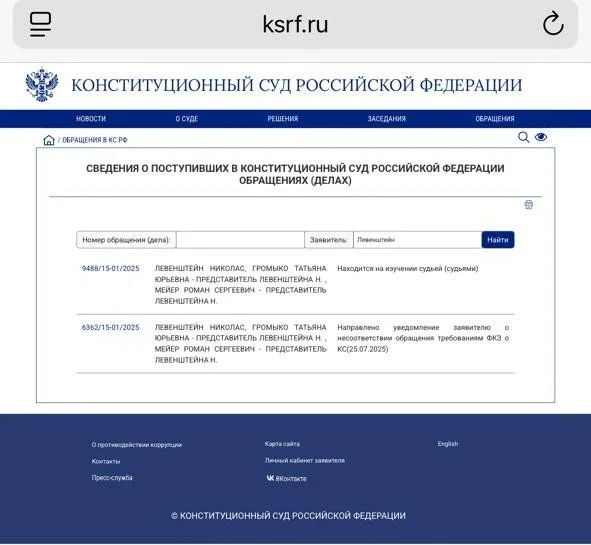
- KSRF Petition No. 9488/15-01/2026 — status: “Under review / being studied by a judge (judges)” (Находится на изучении судьей (судьями)).
- KSRF Petition No. 6362/15-01/2026 — status: “Notice sent to the applicant regarding non-compliance with formal requirements of the Federal Constitutional Law on the Constitutional Court” (procedural/administrative notice).
- Jan 29, 2026 – Ruling No. 181-O: the Constitutional Court refused to accept the renewed complaint for consideration. The ruling is final and cannot be appealed (Ruling No. 181-O, Russian PDF).
- Status link (may be inaccessible outside Russia): KSRF Current Status Portal Search (Левенштейн)
Court record (KSRF, January 2026): complaint registered and under study – before the refusal of January 29, 2026
Legal Opinion on Guardianship Violations (2025)
This legal research opinion, prepared under Agreement No. 2025-118-1 dated May 20, 2025, investigates the legality of transferring Leon Levenstein (born 27 February 2020) into the guardianship of Andrei Yuryevich Malevany. It was conducted to identify violations committed by Moscow’s guardianship officials and the guardian himself during the appointment and supervision process.
Key Findings:
- No notification was sent to the U.S. diplomatic mission or competent foreign authority despite Leon’s foreign citizenship.
- Authorities failed to prepare or register the mandatory “Child Profile” or include Leon in the state database of children left without parental care.
- Leon’s father’s details—Nicholas Levenstein’s contact information and passport data—were omitted from official records.
- No court decision or law enforcement evidence confirmed the “loss of parental care.”
- Authorities ignored the grandmother’s preferential right to guardianship and failed to document her refusal.
- Failure to verify criminal record and authenticity of Malevany’s income certificate.
- Guardian left Moscow with the child without notifying authorities, violating the order of supervision; no official sanction followed.
Conclusion:
The report concludes that the guardianship authority’s conduct grossly violated Leon Levenstein’s rights and may constitute an administrative offense under Article 5.36 of the Russian Code of Administrative Offenses (“Failure of officials to provide timely or accurate information regarding minors in need of guardianship”).
Full Text:
- English Version (.docx)
- Legal Opinion – Russian Original (.pdf)
- Case Dossier – Russian (.pdf) (Досье по обстоятельствам дела Николаса и Леона Левенштейнов; not the legal opinion)
Court Decision Denying Visitation (12 December 2025)
On 12 December 2025, the court issued a decision denying the application regarding visitation / determination of a communication procedure. The decision, its English translation, and the audio recording of the court hearing are linked below:
- Russian decision (PDF): 12.12.2025-judgment-rendered.pdf
- English translation (DOCX): 12.12.25.-english-trnaslation-of-court-decision.docx
- Audio recording of court hearing (MP4): 2025-12-12-audio-of-court-hearing.mp4
Full English Translation: 12 December 2025 Court Decision
IN THE NAME OF THE RUSSIAN FEDERATION
COPY
COPY
December 12, 2025, City of Moscow
The Golovinsky District Court of the City of Moscow, composed of presiding judge O.M. Ivanova, with secretary K.P. Blinova, having considered in an open court session civil case No. 2-3865/2025 on the lawsuit of Nicolas Loewenstein against Andrey Yuryevich Malevany, regarding the non-creation of obstacles in communicating with a minor, determining the procedure for communicating with a child, and compelling actions,
ESTABLISHED:
The Plaintiff, N. Loewenstein, filed a lawsuit with the court against the Defendant, A.Yu. Malevany, clarified on the basis of Article 39 of the Civil Procedural Code of the Russian Federation during the consideration of the case, in which he requested:
- to oblige the defendant to eliminate obstacles in the communication of N. Loewenstein with his son Leon Loewenstein, born on February 27, 2020;
- to establish within six months from the moment the court decision enters into legal force an adaptation period, during which, in each period of N. Loewenstein's stay on the territory of the Russian Federation, to oblige the guardian A.Yu. Malevany to provide the father, N. Loewenstein, with access to the minor Leon Loewenstein in the presence of the guardian A.Yu. Malevany at the place of residence of the minor Leon Loewenstein at the address: Moscow, Kronshtadtsky Boulevard, building 49, block 1, apt. 198, on weekends - Saturday and Sunday in the period from 12:00 to 15:00, as well as on one weekday in the period from 18:00 to 19:00. At such meetings, at the initiative of Nicolas Loewenstein, a translator provided by N. Loewenstein may be present. To oblige the guardian A.Yu. Malevany, if there are grounds for restricting the meeting due to the illness of Leon Loewenstein, to provide upon the request of the father Nicolas Loewenstein documents confirming the illness;
- within 1 year after the completion of the adaptation period, to oblige the guardian A.Yu. Malevany to grant the father N. Loewenstein access to the minor Leon Loewenstein for each period of his stay in the Russian Federation daily, excluding weekends and holidays, from 16:00 to 20:00, taking into account the health condition and observance of the child's daily routine, with the right to visit places of leisure, culture, and recreation without the presence of the guardian;
- every Saturday and Sunday of the month, as well as holidays from 10:00 to 19:00, upon agreement with the guardian, without the presence of the guardian, taking into account the child's health condition, observing the child's daily routine, and with the right to visit places of leisure, culture, and recreation.
- To oblige the guardian A.Yu. Malevany, if there are grounds to restrict the meeting due to the illness of Leon Loewenstein, to provide upon the request of the father Nicolas Loewenstein documents confirming the illness;
- upon the expiration of a year after the court decision enters into legal force, to oblige the guardian A.Yu. Malevany to provide N. Loewenstein with the opportunity to spend a vacation together with the child abroad for at least 2 weeks once every two months at the address: Canggu, Bali G Blue Villa, Jl. Subak Sari No 13, Kuta Utara district, Badung regency, Bali 80361 (Villa G Blue addressed in Komplek B Garden, Canggu, Kec. Kuta Utara Kabupaten Badung, Bali 80361), for which to lift the ban on the minor Leon Loewenstein, born on 27.02.2020, traveling abroad with his only parent and to formalize all necessary documents.
In support of the claim, it is stated that the plaintiff is the biological father of the minor Leon Loewenstein, born on 27.02.2020, his parental rights regarding the child have not been restricted or terminated, and there are no court decisions on the deprivation or restriction of parental rights.
After the death of the child's mother on 05.12.2023, temporary guardianship over the minor was established in favor of the maternal uncle — the defendant, while the basis for establishing guardianship served inaccurate information about the absence and evasion of the father from raising the child.
Actually, the plaintiff, from the moment of the child's birth, participated in his upbringing, maintenance, and education, maintained a stable emotional connection with him, which was confirmed by the materials of the court proceedings and was not disputed by the defendant.
The defendant, being a temporary guardian, intentionally prevents the plaintiff from communicating with the child, concealed information about the death of the child's mother, blocked all methods of communication, evades interaction with the plaintiff and guardianship authorities, does not inform the child about the existence of the father and his desire to communicate, and also actually changed the child's place of residence without the agreement of the guardianship authority.
The actions of the defendant violate the rights of the plaintiff as a parent, as well as the child's right to communicate and be raised in the family of his native father, contradict the requirements of the Family Code of the Russian Federation, and do not meet the interests of the minor.
There are no legal grounds for restricting the plaintiff's communication with the child; threats to the life, health, and mental development of the child from the plaintiff have not been established.
Due to the defendant's evasion of interaction and the absence of an agreement between the parties, the plaintiff is forced to apply to the court with claims to eliminate obstacles in communicating with the child and to determine the procedure for communication, as well as to resolve the issue of the minor's maintenance.
The plaintiff, N. Loewenstein, did not appear at the court hearing, was duly notified by the court of the time and place of the court hearing, and ensured the appearance in court of his representatives, who supported the claims in full during the court hearing.
The defendant, A.Yu. Malevany, did not appear at the court hearing, was duly notified by the court of the time and place of the court hearing, ensured the appearance in court of his representative, who did not recognize the claim, considered it not subject to satisfaction, according to the arguments of the submitted written response to the statement of claim, according to which he indicated that the defendant knows that in 2022 the plaintiff, during the short-term stay of the minor Leon Loewenstein outside the Russian Federation, took actions to arbitrarily retain the child from the mother, in connection with which the latter applied to the competent authorities of a foreign state.
After a sharp deterioration in the health of the child's mother and her subsequent death, the plaintiff did not take prompt measures to arrive in the Russian Federation and actually evaded the exercise of parental duties with respect to the child left without parental care.
In order to protect the rights and legitimate interests of the minor, the guardianship and trusteeship authority, in accordance with Federal Law No. 48-FZ "On Guardianship and Trusteeship", established preliminary guardianship over the child.
The plaintiff repeatedly insisted on transferring the minor to third parties for taking him outside the Russian Federation; however, it was explained to him that the issues of the child's departure and his transfer to the parent fall within the competence of the guardianship and trusteeship authorities.
Having applied to the guardianship authorities after a significant period of time, the plaintiff to date has not submitted a complete set of documents confirming the existence of conditions for the child's residence, as well as information on the absence of a criminal record, which prevents the consideration of the issue of transferring the minor to the plaintiff pursuant to Articles 65-68 of the Family Code of the Russian Federation. Earlier, the plaintiff filed claims for the transfer of the minor to leave for permanent residence in the Republic of Malta; however, by the judicial acts of the Tverskoy District Court of Moscow and the Moscow City Court, which entered into legal force, the satisfaction of these claims was denied.
The plaintiff's claims to lift restrictions on the minor's travel outside the Russian Federation do not meet the child's interests, as they create a risk of the impossibility of his return, are inconsistent with his educational routine and medical recommendations, and are not justified by the need for such frequent trips to foreign countries.
The representative of the Territorial Department for Guardianship and Trusteeship No. 5 of the Guardianship and Trusteeship Directorate of the Department of Labor and Social Protection of the Population of the City of Moscow appeared at the court session and submitted a written conclusion on the case.
In accordance with the provisions of Part 3 of Article 167 of the Civil Procedural Code of the Russian Federation, the trial was held in the absence of the non-appearing persons duly notified of the time and place of the court session and who did not provide information on the reasons for their non-appearance.
Having heard the arguments of the parties' representatives, the conclusion of the authorized body in the field of guardianship and trusteeship, and having examined the materials of the civil case, the court came to the following conclusion.
Part 1 of Article 38 of the Constitution of the Russian Federation proclaims that motherhood and childhood, as well as the family, are under state protection.
By virtue of the provisions of Article 3 of the UN Convention "On the Rights of the Child", approved by the UN General Assembly on November 20, 1989, in all actions concerning children, whether undertaken by public or private social welfare institutions, courts of law, administrative authorities or legislative bodies, the best interests of the child shall be a primary consideration.
States Parties recognize the right of every child to a standard of living adequate for the child's physical, mental, spiritual, moral and social development (paragraph 1 of Article 27 of the UN Convention "On the Rights of the Child").
Since the plaintiff is a parent of the minor, whose parental rights are not restricted and not terminated, and the guardian is obliged by law not to hinder the exercise of the parent's rights, the provisions of the Family Code of the Russian Federation regulating the child's right to communicate with parents and the procedure for exercising parental rights, regardless of the establishment of guardianship, are subject to application in the dispute under consideration.
According to Part 1 of Article 55 of the Family Code of the Russian Federation, a child has the right to communicate with both parents, a grandfather, grandmother, brothers, sisters, and other relatives.
In accordance with Art. 54 of the Family Code of the Russian Federation, a person who has not reached the age of eighteen (majority) is recognized as a child.
Every child has the right to live and be raised in a family, as far as possible, the right to know his/her parents, the right to their care, the right to live together with them, except in cases where this contradicts his/her interests.
The child has the right to be brought up by his/her parents, ensuring his/her interests, all-round development, and respect for his/her human dignity.
In accordance with Art. 55 of the Family Code of the Russian Federation, a child has the right to communicate with both parents, a grandfather, grandmother, brothers, sisters, and other relatives.
The dissolution of the parents' marriage, the recognition of it as invalid, or the separate residence of the parents do not affect the rights of the child.
In case of separate residence of the parents, the child has the right to communicate with each of them.
A child has the right to communicate with his/her parents also in the event of their residing in different states.
Based on Art. 61 of the Family Code of the Russian Federation, parents have equal rights and bear equal responsibilities regarding their children (parental rights).
Parental rights terminate upon children reaching the age of eighteen (majority), as well as upon minor children entering into marriage and in other cases established by law when children acquire full legal capacity before reaching majority.
In accordance with Art. 65 of the Family Code of the Russian Federation, parental rights cannot be exercised in contradiction to the interests of children.
Ensuring the interests of children must be the subject of primary concern for their parents.
When exercising parental rights, parents do not have the right to cause harm to the physical and mental health of children, to their moral development.
Methods of raising children must exclude neglectful, cruel, rude, degrading treatment, insult, or exploitation of children.
Parents exercising parental rights to the detriment of the rights and interests of children bear responsibility in the manner established by law (Part 1).
All issues concerning the upbringing and education of children are decided by parents by mutual consent, proceeding from the interests of the children and taking into account the opinion of the children.
Parents or one of them, in case of disagreement between them, has the right to apply to the guardianship and trusteeship authority or to the court for the resolution of these disagreements (Part 2).
In accordance with Art. 66 of the Family Code of the Russian Federation, a parent residing separately from the child has the right to communicate with the child, participate in his/her upbringing, and decide issues of the child obtaining an education.
By virtue of paragraph 8 of the Resolution of the Plenum of the Supreme Court of the Russian Federation dated May 27, 1998, No. 10 "On the Application by Courts of Legislation in Resolving Disputes Related to the Upbringing of Children", in accordance with paragraph 2 of Art. 66 of the Family Code of the Russian Federation, parents have the right to conclude a written agreement on the procedure for the exercise of parental rights by a parent residing separately from the child.
If the parents cannot reach an agreement, the dispute that has arisen is resolved by the court at the request of the parents or one of them with the participation of the guardianship and trusteeship authority.
Proceeding from the right of a parent residing separately from the child to communicate with him, as well as from the need to protect the rights and interests of the minor when communicating with this parent, the court, taking into account the circumstances of each specific case, should determine the procedure for such communication (time, place, duration of communication, etc.), setting it out in the operative part of the decision.
When determining the procedure for communication between a parent and a child, the child's age, health condition, attachment to each of the parents, and other circumstances capable of affecting the physical and mental health of the child and his moral development are taken into account.
As explained in the third paragraph of Item 8 of the resolution of the Plenum of the Supreme Court of the Russian Federation dated May 27, 1998, No. 10 "On the Application by Courts of Legislation in Resolving Disputes Related to the Upbringing of Children", when determining the procedure for communication between parents and a child, the child's age, health condition, attachment to each of the parents, and other circumstances capable of affecting the physical and mental health of the child and his moral development are taken into account.
Thus, from the above provisions of the law, it follows that the right of parents to raise their children and to communicate with them is paramount in relation to other relatives, including grandmothers and grandfathers, in connection with which the latter are not entitled to demand communication with grandchildren to the same extent as it is granted to their parents.
The opposite would lead to an unjustified decrease in the volume of parents' rights, which is unacceptable from the point of view of the law.
According to Art. 56 of the Civil Procedural Code of the Russian Federation, each party must prove the circumstances to which it refers as grounds for its claims and objections, unless otherwise provided by federal law.
As established by the court and follows from the materials of the case and the explanations of the parties, the plaintiff N. Loewenstein and A.Yu. Lyudinovskova are the parents of Leon Loewenstein, born on February 27, 2020.
On 05.12.2023, A.Yu. Lyudinovskova died (death record No. 170239775005802245001 dated 06.12.2023, death certificate XI-MJ No. 733800 issued by Civil Registry Office of Moscow No. 58 MFC of Perovo district on 06.12.2023).
By order dated 06.12.2023 No. 1187-OP of the Social Protection Department of the Golovinsky District of the Social Protection Directorate of the Northern Administrative Okrug of the City of Moscow of the Department of Labor and Social Protection of the Population of the City of Moscow, in connection with the mother's death, preliminary guardianship was established over the minor Leon Loewenstein, born on February 27, 2020.
Temporarily, for a period of up to six months, A.Yu. Malevany was appointed guardian of the minor Leon Loewenstein, born on February 27, 2020.
By order dated 06.06.2024 No. 01/5-14-303/24 of the Department of Labor and Social Protection of the Population of the City of Moscow, the term of preliminary guardianship established by the order of the Social Protection Department of the Golovinsky District of the Social Protection Directorate of the Northern Administrative Okrug of the City of Moscow of the Department of Labor and Social Protection of the Population of the City of Moscow from December 06, 2023 No. 1187-OP "On establishing preliminary guardianship over the minor Leon Loewenstein, born on February 27, 2020", was extended up to two months.
By the order of the Department of Labor and Social Protection of the Population of the City of Moscow dated 05.08.2024 No. 01/5-20-2/24, guardianship was established over the minor L. Loewenstein, born on February 27, 2020, and A.Yu. Malevany was appointed as the minor's guardian from the date of issuance of this order.
From the documents submitted by the plaintiff, it follows that he, as the child's father, repeatedly applied to the Department of Labor and Social Protection of the City of Moscow through the State Budgetary Institution "My Family Center 'Preobrazhenie'" with applications for the transfer of his son and ensuring the possibility of meetings with him, as well as with complaints about the guardian's actions.
The court established that by the decision of the Tverskoy District Court of Moscow dated July 08, 2024, in case No. 2-3254/2024, the court denied the satisfaction of the lawsuit of N. Loewenstein against A.Yu. Malevany concerning the return of the child.
By the decision of the Basmanny District Court of the City of Moscow dated March 10, 2025, in case No. 2-698/2025, the court denied the satisfaction of the claims of N. Loewenstein against the Department of Labor and Social Protection of the Population of Moscow and A.Yu. Malevany to recognize actions as illegal, cancel orders, and oblige to transfer the child to the parent.
In court, the plaintiff's side presented a social report on the suitability of a foreign citizen for guardianship over a child from the Ministry of Social Affairs of the Republic of Indonesia, Directorate General of Social Rehabilitation, Department of Social Rehabilitation of Children, according to which N. Loewenstein has the conditions for the child's residence.
The house where N. Loewenstein lives is a rented villa under a two-year lease agreement: from 08.07.2024 to 08.07.2026, concluded between the owner of the villa and Nicolas Loewenstein.
The area of the villa is about 300 sq.m. It consists of 3 bedrooms, a living room, a kitchen, and a play area.
The villa is equipped with a swimming pool and an open space for children's games. The living quarters are in good condition, clean, well-ventilated, and illuminated.
Based on the results of the social investigation, Nicolas Loewenstein can be characterized as a father with good physical and mental health, a stable financial position, positive life values, a favorable home environment, and responsible parenting methods.
Nicolas Loewenstein is capable of raising, caring for, and educating a child.
At the request of the court, specialists from the Territorial Department for Guardianship and Trusteeship No. 5 of the Guardianship and Trusteeship Directorate conducted an inspection of the living conditions of the family of the defendant A.Yu. Malevany and the minor Leon Loewenstein at the address: Moscow, Kronshtadtsky Blvd, bld. 49, build. 1, apt. 198.
According to the act of inspection of the living premises in which the minor resides, dated 29.09.2025 No. 01/5-30-989/25, it was established that the living premises are a separate, well-appointed two-room apartment.
A separate room has been allocated for Leon's use, in which the necessary conditions for the residence and full development of the child have been created; there is a sleeping place, a closet for storing belongings, an equipped area for games and activities, and there are toys.
The relationship between the guardian and the child is benevolent. The sanitary and hygienic condition of the living space is satisfactory.
Based on the results of the inspection, it was established that the apartment has all the necessary conditions for the minor's residence, and the defendant has the ability to provide for the basic needs of the child.
In a conversation with a specialist of labor and trusteeship No. 5 of the Guardianship and Trusteeship Directorate of the Department of Labor and Social Protection of the Population of Moscow during the social protection of the population of Moscow, conducted during the inspection, A.Yu. Malevany explained that he is the guardian of the minor Leon Loewenstein on the basis of the order of the Territorial Department for Guardianship and Trusteeship No. 5 of the Guardianship and Trusteeship Directorate of the Department of Labor and Social Protection of the Population of Moscow dated 03.08.2024 No. 01/5-20-2/24 "On establishing guardianship over the minor Leon Loewenstein, born on 27.02.2020";
- the father does not take part in the upbringing and maintenance of the child; Leon does not remember his father, as in 2023 the plaintiff stopped communicating with the mother of the minor L. Loewenstein;
- after the establishment of guardianship, the plaintiff made several attempts to abduct the child, but he did not file claims in court to transfer the child to him for upbringing;
- N. Loewenstein only put forward demands to return the child to his country of birth, the Republic of Malta, where the plaintiff does not reside;
- in 2024, the Tverskoy and Basmanny District Courts of Moscow imposed a ban on the minor L. Loewenstein crossing the border of the Russian Federation; the minor L. Loewenstein has dual citizenship: the Russian Federation and the Republic of Malta.
The Department of Labor and Social Protection of the Population of the City of Moscow submitted a conclusion on the case regarding the claims stated by the plaintiff, according to which the guardianship and trusteeship authority believes that proceeding from the interests of the minor, taking into account that N. Loewenstein and the minor Leon Loewenstein, born on 27.02.2020, reside in different countries, the plaintiff does not reside permanently on the territory of the Russian Federation and has no place of residence, considering that the minor Leon Loewenstein does not know and does not remember his biological father, and the plaintiff has not participated in the upbringing of the minor Leon Loewenstein for a long time, the claims of N. Loewenstein regarding the determination of the procedure for communication with the minor Leon Loewenstein, born on 27.02.2020, are filed prematurely.
In addition, given the need to establish child-parent relations between the father and the child, the Department of Labor and Social Protection of the Population of the City of Moscow considers that concluding an amicable agreement between N. Loewenstein and A.Yu. Malevany on the procedure for the father's communication with his son will fully correspond to the interests of the minor Leon Loewenstein, born on 27.02.2020.
Evaluating the stated claims in conjunction with the submitted evidence and the conclusion of the guardianship and trusteeship authority, and also taking into account the goals of judicial protection of family rights, the court concludes that there are no grounds for satisfying the claims to oblige the guardian not to create obstacles in communication and to establish a detailed procedure for communication through a compulsory judicial procedure.
Although the plaintiff retains the status of a parent and his parental rights are not restricted or terminated, the very existence of parental status does not entail an automatic obligation for the court to determine a specific and extended communication procedure if such intervention at this stage does not meet the interests of the child and the need for judicial protection precisely to the extent claimed is not confirmed.
The court proceeds from the fact that determining the procedure for communication is a measure of legal impact applied in the presence of an ongoing conflict that hinders the realization of parental rights and is not amenable to settlement by other means, provided that such intervention contributes to, and does not hinder, the well-being of the minor.
Having evaluated the body of evidence, the court came to the conclusion that the stated claims are premature in nature, since they imply a complex and multi-stage regulation of communication, including lengthy meetings, travel outside the Russian Federation, and an actual change in the child's usual way of life, in the absence of formed and stable child-parent relationships, as well as while issues related to guardianship, place of residence, and the international element of legal relations are continuing to be resolved.
Under such conditions, judicial establishment of a communication procedure to the extent claimed cannot be considered as a measure directly aimed at protecting the child's interests.
In addition, the court takes into account that the Family Code of the Russian Federation proceeds from the priority of the voluntary and coordinated exercise of parental rights, and judicial intervention should bear an auxiliary, and not a substitutive, character.
In the absence of evidence of systematic and unlawful obstruction of communication requiring immediate suppression on a mandatory basis, the court does not see grounds for imposing specific obligations on the defendant in the form claimed by the plaintiff.
At the same time, the refusal to satisfy the stated claims does not mean a denial of the plaintiff's very right to communicate with the child.
On the contrary, the court proceeds from the need to preserve and gradually restore family ties, taking into account the child's age, his emotional state, and the principle of the best provision of his interests.
In this regard, the court considers it possible and advisable to limit itself to a recommendatory measure addressed to the guardian as the legal representative of the minor.
The court recommends that A.Yu. Malevany not create obstacles to Nicolas Loewenstein's communication with his minor son Leon Loewenstein, born on 27.02.2020, based on the need to preserve and gradually develop child-parent ties, the priority of the minor's interests, and the advisability of forming such communication extrajudicially, without establishing a strict and detailed regulated judicial procedure, allowing the parties to work out an agreed format of interaction or use the assistance of the guardianship and trusteeship authority.
Thus, the court, refusing to satisfy the stated claims, maintains a balance between protecting the parental rights of the plaintiff and ensuring the stability of the child's living conditions, emphasizing the priority of his interests and leaving the parties with the opportunity for a voluntary settlement of the issue of communication or repeated appeal to the court upon a change of circumstances.
Based on the foregoing, guided by Articles 194-198 of the Civil Procedural Code of the Russian Federation, the court
DECIDED:
To deny the satisfaction of the claims of Nicolas Loewenstein against Andrey Yuryevich Malevany regarding the non-creation of obstacles in communicating with a minor, determining the procedure for communicating with a child, and compelling actions.
To recommend that Andrey Yuryevich Malevany not create obstacles to Nicolas Loewenstein's communication with his minor son Leon Loewenstein, born on February 27, 2020.
Measures to secure the claims of Nicolas Loewenstein against Andrey Yuryevich Malevany regarding the non-creation of obstacles in communicating with a minor, determining the procedure for communicating with a child, and compelling actions, imposed by the ruling dated November 25, 2025 on determining the procedure for communication of a parent living separately with the child for the period until the court decision enters into legal force — shall be canceled.
The decision may be appealed to the Moscow City Court within one month from the date of manufacture of the decision in final form by filing an appeal through the Golovinsky District Court of the City of Moscow.
The decision in final form was manufactured on 06.02.2026
Judge: O.M. Ivanova
Counsel Memorandum (December 2025)
For readers who wish to review the referenced court file and translation:
- Russian court file (Judge’s opinion, PDF): Judge-Opinion-12.12.2025-15.05.pdf
- English translation (DOCX): English-Translation-from-Tatiana-file-sent-Dec-15.docx
Good evening, Nicholas!
While preparing this message, we struggled for a long time to find the right words to describe the situation, because what happened in court, in our view, went far beyond any acceptable deviations, and today’s incident is so outrageous that it deserves to be examined independently in the history of unjust judicial decisions. When applying to the court with a request to determine the procedure for communication, we were guided by Article 66 of the Family Code of the Russian Federation, according to which, in the event of disagreements between parents or guardians regarding the upbringing or communication with a child, such a procedure is established by the court.
By its meaning, this legal provision implies that the court has no possibility to refuse as such; it may only determine the procedure for communication. That is, the court may disagree with the number of days, the duration, or the period of communication; it may establish significantly less than what one party requests, or impose an obligation for such communication to take place under the supervision of third responsible persons—but it cannot refuse outright.
The very wording of the law excludes such a possibility for the court, since restricting a parent’s communication with a child is permitted only in cases where the parent has been restricted or deprived of parental rights in the manner prescribed by law.
Thus, when applying to the court, we understood that the court would significantly limit our right to communicate, but would nevertheless grant a right of access.
Moreover, back in the Basmanny Court, Judge Guseva directly drew our attention to the fact that we needed to apply to the court to determine the procedure for communication.
However, to our astonishment, we cannot now even imagine, nor can we assume, on the basis of what law the court refused us. What it will place at the foundation of its decision and how it will justify such a refusal remains unclear, but the fact remains.
The guardianship authority, to our surprise, agreed with the opinion of the guardianship and trusteeship body, which leaves us perplexed.
We will send you the opinion of the guardianship authority, and I believe you will be no less shocked by its content.
Thus, contrary to all facts and reality, the guardianship authority stated that we applied to the court prematurely and that we need to resolve this issue with Andrei through a settlement agreement. We were in complete disbelief upon reading this opinion and immediately noted that entering into a settlement agreement had been proposed to Andrei by the authorized body; we ourselves repeatedly contacted the guardianship authority, and moreover, the court directly raised this issue during the hearing. However, Andrei refused any settlement agreement. We then raised the question before the guardianship and trusteeship authority as to how, seeing this and knowing all the circumstances, they consider it possible to conclude such a settlement agreement. Naturally, this question was immediately ignored, and no one even considered it necessary to respond.
We honestly admit that, of course, we will prepare an appeal and appear before the cassation court on 18 December 2025, but we have stopped believing that you can restore your right within the Russian justice system.
In every document, judicial act, decision, or ruling, we desperately searched for a reference to the truth or an indication of a mistake we had made, a misapplied law; however, instead, we saw only mockery of the very idea of administering justice.
It seems absolutely incredible to us to hear a statement about the need to refuse because a settlement agreement should be concluded, when the guardianship authority makes such a statement while obviously knowing that the other party (the guardian) does not wish to do so. And even more shocking is the court’s agreement with such an opinion, when the court itself proposed concluding a settlement agreement and received a refusal. But what will shock you even more is the following: we will send you an audio recording in which the judge, having refused us, directly states that she nevertheless recommends that the defendant not create obstacles. We are deeply shocked when a judge refuses us a decision, yet immediately thereafter, in her own speech, without embarrassment, says that she believes the defendant should not create obstacles.
Nicholas, at the moment we cannot express an opinion on further actions—we need to rest, and Roman Meyer has fallen ill due to stress. On Monday, we will prepare our letter with our view on the next steps.
December 2025 Lawyer’s Note – Strategy & “Dolina Case” (External Update)
Short description: This external update links to the “Strategy & The ‘Dolina Case’ Precedent” section of the December 25 letter translation. It argues that legal appeals are likely to keep being ignored unless the case becomes publicly visible in political circles, and it cites the widely publicized “Dolina Case” as an example of how intense public scrutiny can pressure outcomes in high-profile Russian proceedings.
Link: https://www.bringleonhome.org/december2025lawyersnote#strategy
AI Analysis: Judicial Bias in the Levenstein Case (External Update)
Short description: This external update links to a bilingual AI-focused write-up that compares how three systems (Gemini, Grok, and OpenAI) frame the feasibility, risks, and methodology of using generative AI to assess potential systemic discrimination and judicial bias patterns in an international custody context.
Link: https://www.bringleonhome.org/new-ai-research
Nicholas’ Reply to the Lawyers’ Memorandum (December 2025)
Read Nicholas' reply to the lawyers' memo above here: https://www.bringleonhome.org/nickreplydec252025
Counsel Memorandum Update (February 2026)
New Court Documents & Updates:
- Reasoned Decision – Golovinsky District Court (Russian PDF): Download PDF
- Reasoned Decision – English Translation (DOCX): Download DOCX
- Constitutional Court Ruling No. 181-O of January 29, 2026 – complaint not accepted, final (PDF): KSRFDecision889869-1.pdf
Summary of Counsel's Recent Status Update:
In a recent status update, the legal team confirmed receipt of the reasoned decision from the Golovinsky District Court, which formally denied the visitation claims. The lawyers described the ruling as highly unprofessional and contrary to the core purpose of protecting child-parent communication rights, noting the paradox that the court still included a non-binding recommendation for the guardian not to interfere with this communication. In response, the team is preparing an appeal to the Moscow City Court against the Golovinsky decision, as well as a complaint to the Supreme Court of the Russian Federation regarding the original guardianship transfer handled by the Basmanny Court. Following an extensive review by Chairman Valery Zorkin and other judges, the team's recent Constitutional Court complaint was returned with instructions to first exhaust all Supreme Court appeal mechanisms, after which they plan to re-file. Tactically, the lawyers will formally request the guardian to comply with the court's non-binding recommendation; anticipating his refusal, they intend to use this non-compliance in higher courts to demonstrate the absurdity and ineffectiveness of the lower court's legal remedy. Alongside these judicial efforts, the team continues negotiations with the Children's Rights Commissioner and is drafting formal letters to the Ministry of Education and local guardianship authorities. Finally, the legal team expressed their deep sympathy for Nicholas and Leon, lamenting that they are unable to celebrate the child's birthday together for the third consecutive year.